17 - Inverse Modelling with Evaporation
Black Sea water evaporated until halite precipitates, and whether a short list of processes can account for every major ion in the result.
The hypothesis under test is specific: that evaporation, precipitation of calcite, gypsum and halite, and loss of CO₂ are enough to explain the difference between the initial water and the evaporated one – for all the major ions and for bromide.
Bromide is there as the control. It forms no mineral under these conditions, so it can only be concentrated by evaporation, and it therefore says how much water was lost independently of everything else. Any model that gets bromide wrong is wrong, whatever it does for the rest.
Evaporation as a mole transfer
TITLE Example 17.--Inverse modeling of Black Sea water evaporation
SOLUTION 1 Black Sea water
units mg/L
density 1.014
pH 8.0 # estimated
Ca 233
Mg 679
Na 5820
K 193
S(6) 1460
Cl 10340
Br 35
C 1 CO2(g) -3.5
SOLUTION 2 Composition during halite precipitation
units mg/L
density 1.271
pH 5.0 # estimated
Ca 0.0
Mg 50500
Na 55200
K 15800
S(6) 76200
Cl 187900
Br 2670
C 1 CO2(g) -3.5
INVERSE_MODELING
-solution 1 2
-uncertainties .025
-range
-balances
Br
K
Mg
-phases
H2O(g) pre
Calcite pre
CO2(g) pre
Gypsum pre
Halite pre
Glauberite pre
Polyhalite pre
END
Inverse modelling balances mole transfers of phases, so evaporation is included as one: water is treated as a phase that leaves the system, and the amount removed is solved for alongside the minerals.
The second input repeats the calculation with different constraints.
SOLUTION 1 Black Sea water
units mg/L
density 1.014
pH 8.0 # estimated
Ca 233
Mg 679
Na 5820
K 193
S(6) 1460
Cl 10340
Br 35
C 1 CO2(g) -3.5
EQUILIBRIUM_PHASES
# carbonates...
CO2(g) -3.5 10; Calcite 0 0
# sulfates...
Gypsum 0 0; Anhydrite 0 0; Glauberite 0 0; Polyhalite 0 0
Epsomite 0 0; Kieserite 0 0; Hexahydrite 0 0
# chlorides...
Halite 0 0; Bischofite 0 0; Carnallite 0 0
REACTION
H2O -1; 0 36 3*4 6*1 2*0.25 0.176 4*0.05 5*0.03
INCREMENTAL_REACTIONS true
END
The result
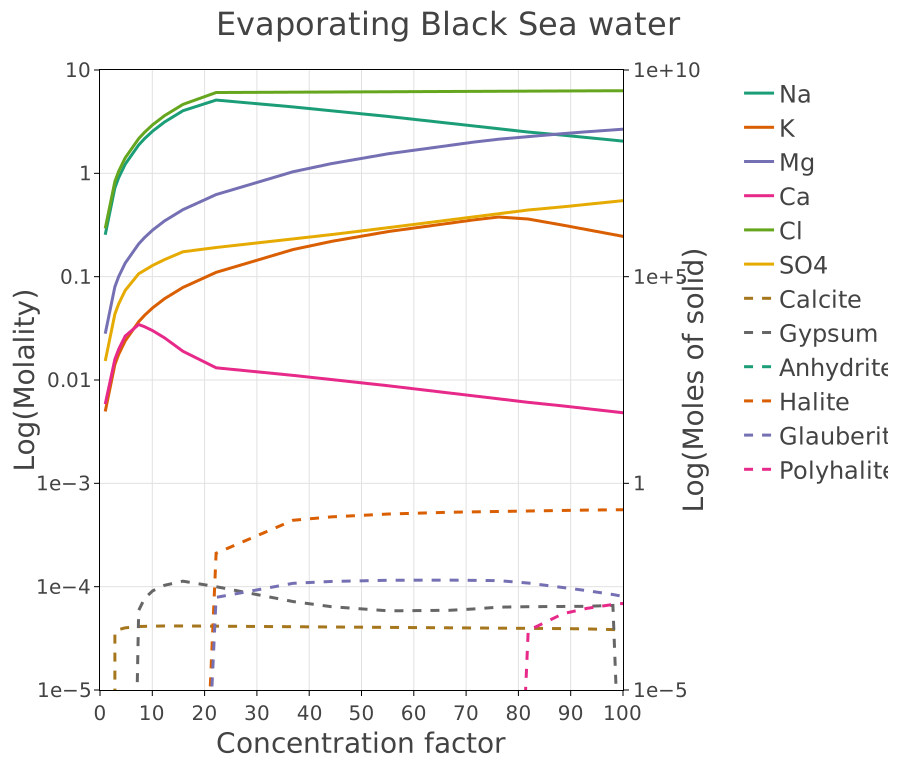
The major ions and the minerals against concentration factor, on a logarithmic scale.
The ions that form no mineral – sodium at first, magnesium, chloride – rise along parallel straight lines, each in step with the concentration factor. That parallel rise is evaporation, and a species that follows it is being concentrated and nothing else.
The departures are the chemistry. Calcite saturates first and removes carbonate. Gypsum follows and takes calcium and sulfate out, so their curves bend away from the evaporation line. Halite is last, at high concentration, and when it arrives sodium and chloride stop rising together with the rest.
Glauberite and polyhalite also appear, which is the part worth dwelling on: the hypothesis named three minerals, and the saturation calculation finds others reaching equilibrium along the way. Whether the hypothesis survives depends on whether they actually precipitated, and that is a question for the evaporite mineralogy, not for the model.
What it shows
That inverse modelling tests a stated hypothesis against data, and that the test is most informative where it fails. A conservative tracer like bromide is what anchors it.
Source
Parkhurst, D. L. and Appelo, C. A. J. (2013). Description of input and examples for PHREEQC version 3. U.S. Geological Survey Techniques and Methods, book 6, chapter A43. This is Example 17 of that manual.
Carpenter, A. B. (1978). Origin and chemical evolution of brines in sedimentary basins. Oklahoma Geological Survey Circular 79, 60-77. The Black Sea evaporation data is from this paper.