03 - Fit Ni Sorption
Two constants again, but fitted to a different kind of experiment: a pH edge. The zinc isotherm of 02 - Fit Langmuir Isotherm held pH fixed and varied the metal; this one holds the metal fixed and varies pH, and what the two constants describe is not capacity and strength but two competing surface reactions.
It is PhreePlot’s nickel sorption example: nickel on goethite, fourteen measurements between pH 4.7 and the alkaline end.
Two reactions, two constants
TITLE Goethite surface 1pK model, Ni sorption 1 site.
PHASES
Fix_H+
H+ = H+
log_k 0.
SURFACE_MASTER_SPECIES
Fes_ Fes_OH-0.5
SURFACE_SPECIES
Fes_OH-0.5 = Fes_OH-0.5 # surface charging
log_k 0.0
Fes_OH-0.5 + H+ = Fes_OH2+0.5
log_k 8.50
2Fes_OH-0.5 + Ni+2 = (Fes_OH)2Ni+ # bidentate model
log_k @{$log_k1$}@
2Fes_OH-0.5 + Ni+2 + H2O = (Fes_OH)2NiOH + H+
log_k @{$log_k2$}@
SURFACE 1
# -diffuse_layer
# -no_edl
Fes_OH-0.5 1.09e-3 32.7 3.33 # goethite parameters
SOLUTION 1
units mol/kgw
Ni 0.4258e-3 # NiT
Na 0.1 # background electrolyte
N(5) 0.1 charge
EQUILIBRIUM_PHASES
O2(g) -0.67 0.1
Fix_H+ -@{$pHobs$}@ NaOH
-force_equality true
Ni(OH)2 0 0
END
The surface is goethite in the 1-pK formulation, with one site type carrying a half charge:
2Fes_OH-0.5 + Ni+2 = (Fes_OH)2Ni+
                     log_k  @{$log_k1$}@

2Fes_OH-0.5 + Ni+2 + H2O = (Fes_OH)2NiOH + H+
                     log_k  @{$log_k2$}@
Both are bidentate – two surface groups to one nickel – and they differ by a proton: the second releases one, the first does not. That single difference is what makes two constants fittable from a pH edge rather than one. A reaction that releases a proton is pushed forward as pH rises, so the two species dominate in different parts of the range, and the data separates them.
The surface charging reaction, Fes_OH-0.5 + H+ = Fes_OH2+0.5 with log K
8.50, is not fitted. It is a property of goethite, measured
independently, and fitting it alongside the nickel constants would let the
solver trade surface charge against metal binding and find an excellent fit
that means nothing. Which parameters are held fixed is as much a part of a
fitting problem as which are free.
The solution is 0.43 mmol/l nickel in 0.1 M NaNO3, equilibrated with oxygen, with pH imposed at each measured value. The residual compares the nickel left in solution:
#Ni_observed# - #Ni#
Both constants start at 8 and are bounded to ±100.
The result
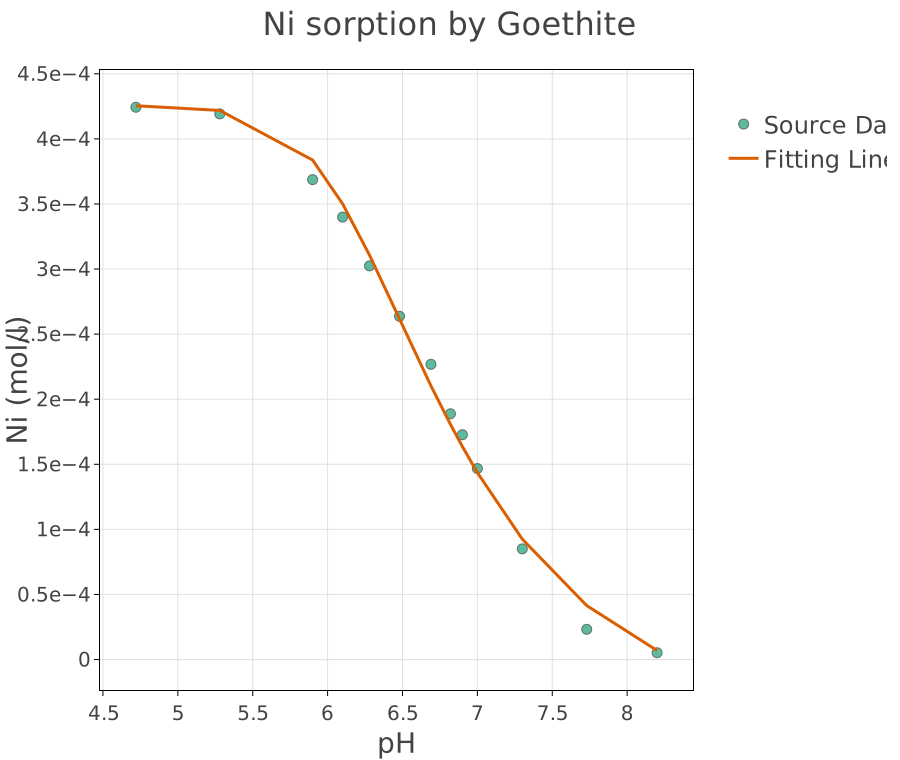
Dissolved nickel against pH: the sorption edge. Nickel stays in solution at low pH, then falls sharply over about two pH units as sorption takes over, and is essentially gone above the edge.
Edges like this are steep because the surface is deprotonating – becoming more negative and so more attractive to a cation – at the same time as the hydrolysed surface species becomes favourable. Both fitted reactions contribute, and the position and the steepness of the edge are what determine them: roughly, the position fixes the first constant and the shape fixes the second.
This is the practical reading, and it mirrors 02 - Fit Langmuir Isotherm. Measurements that do not span the edge will fit, and will not determine anything.
Try it
Fit only
log_k1, holdinglog_k2at its starting value, and see how the edge shape fails to follow the data.Free the surface charging constant as a third parameter and watch the fit improve while the standard errors grow.
Change the nickel concentration and see the edge move, which is the signature of a sorption-controlled system rather than a precipitate.
Source
Kinniburgh, D. G. and Cooper, D. M. (2011). PhreePlot: Creating graphical output with PHREEQC. This is PhreePlot’s nickel sorption fit, including the 1-pK goethite surface and the bidentate model. See the PhreePlot website.
The thermodynamic data is
wateq4f.dat, distributed with PHREEQC (Parkhurst and Appelo, 2013).