07 - Gas Phase Calculations
Organic matter decomposing in a closed system, and the gas that comes off it. The same reaction is run twice, under two different physical constraints, and the two give different answers – which is the point of the example.
A gas phase in contact with a water can be fixed pressure or fixed volume, and they are not interchangeable:
Fixed pressure is a bubble free to grow. It keeps its total pressure and changes size, which is a gas escaping upward through a sediment, or a headspace open to the atmosphere.
Fixed volume is a pore that cannot expand. Its size is set and the pressure rises as gas is produced – a sealed vessel, or gas trapped in a confined formation.
The reaction
TITLE Example 7.--Organic decomposition with fixed-pressure and
fixed-volume gas phases
SOLUTION_MASTER_SPECIES
N(-3) NH4+ 0.0 N
SOLUTION_SPECIES
NH4+ = NH3 + H+
log_k -9.252
delta_h 12.48 kcal
-analytic 0.6322 -0.001225 -2835.76
NO3- + 10 H+ + 8 e- = NH4+ + 3 H2O
log_k 119.077
delta_h -187.055 kcal
-gamma 2.5000 0.0000
PHASES
NH3(g)
NH3 = NH3
log_k 1.770
delta_h -8.170 kcal
SOLUTION 1
EQUILIBRIUM_PHASES 1
Calcite
CO2(g) -1.5
SAVE solution 1
END
# Simulation 2: Decomposition of organic matter, CH2O(NH3).07,
# at fixed pressure of 1.1 atm
USE solution 1
GAS_PHASE 1 Fixed-pressure gas phase
-fixed_pressure
-pressure 1.1
CO2(g) 0.0
CH4(g) 0.0
N2(g) 0.0
H2O(g) 0.0
REACTION 1
CH2O(NH3)0.07 1.0
1. 2. 3. 4. 8. 16. 32 64. 125. 250. 500. 1000. mmol
END
# Simulation 3: Decomposition of organic matter, CH2O(NH3).07,
# at fixed volume of 23.19 L
USE solution 1
USE reaction 1
GAS_PHASE 1 Fixed volume gas phase
-fixed_volume
-volume 23.19
CO2(g) 0.0
CH4(g) 0.0
N2(g) 0.0
H2O(g) 0.0
-equilibrate 1
END
Organic matter is added in increments and decomposes, producing CO₂ and, once conditions are reducing enough, methane. Nitrogen and water vapour make up the rest of the gas.
The results
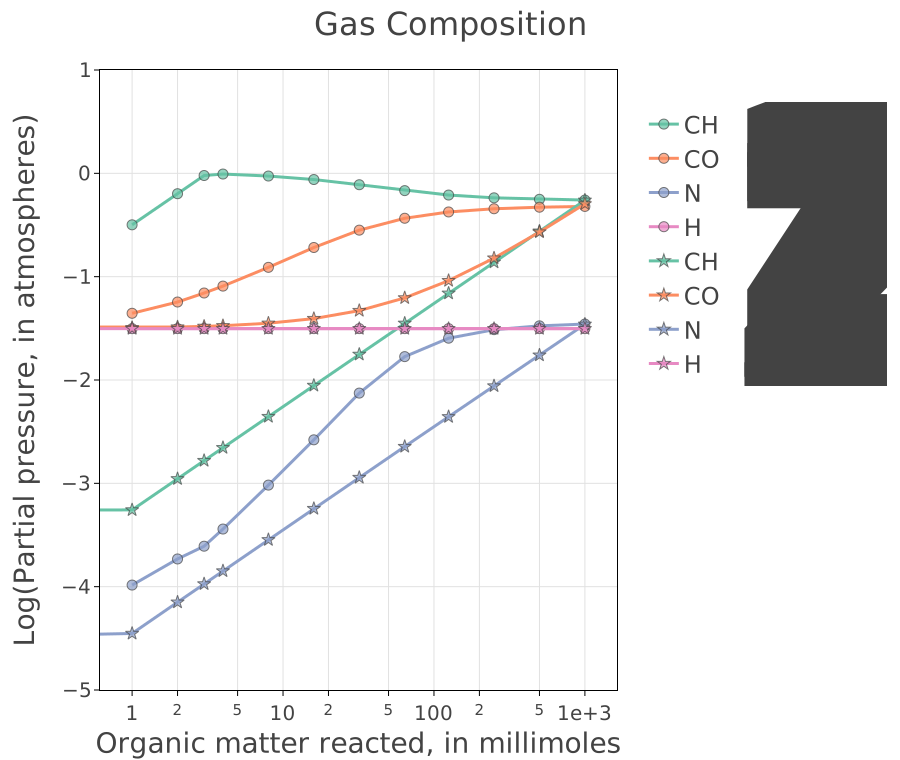
Partial pressures of the four gases against organic matter reacted – the same four species under each constraint, eight curves.
Early on, CO₂ dominates: the organic matter is oxidising and carbon is leaving as carbon dioxide. Later, as the system runs out of oxidant, methane takes over, and the crossover is the transition from oxidising to methanogenic conditions.
The two constraints diverge as soon as there is appreciable gas. Under fixed pressure, producing more gas makes a bigger bubble and the partial pressures are held down by the total staying constant. Under fixed volume the gas has nowhere to go, so the partial pressures climb.
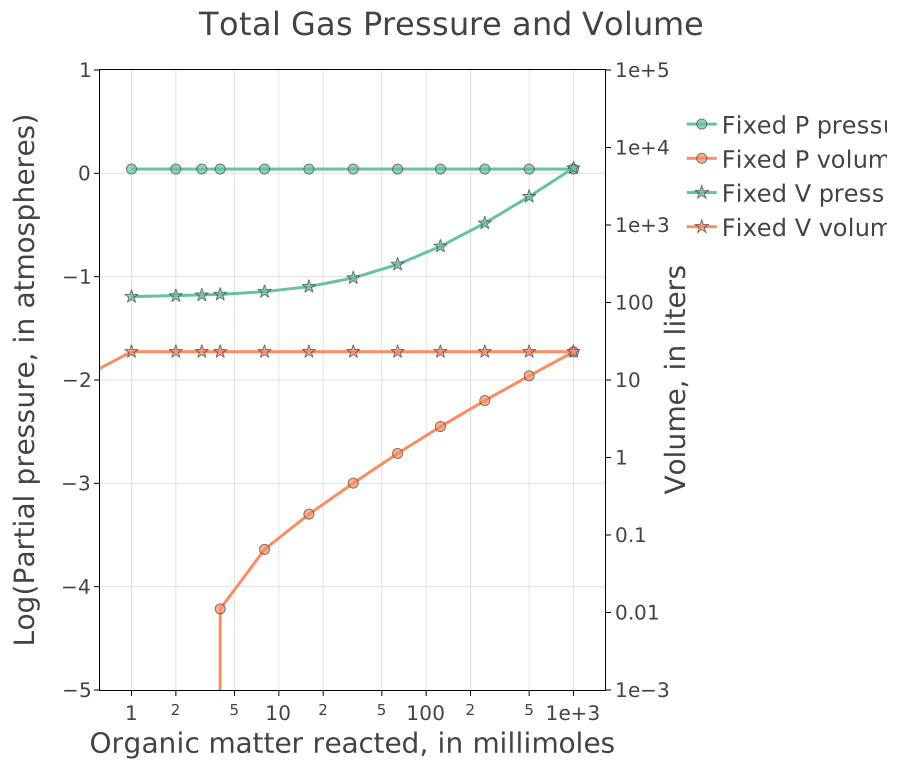
The constraints themselves, which makes the difference explicit: under fixed pressure the pressure is flat and the volume rises; under fixed volume the volume is flat and the pressure rises.
This is the figure to consult when choosing between them for a real problem. The question to ask is whether the gas in your system can expand.
What it shows
That the physical boundary condition on a gas phase is a modelling choice with chemical consequences, and that it has to be made deliberately. Both calculations here are correct; they answer different questions.
Source
Parkhurst, D. L. and Appelo, C. A. J. (2013). Description of input and examples for PHREEQC version 3. U.S. Geological Survey Techniques and Methods, book 6, chapter A43. This is Example 7 of that manual.