03 - Calcite and Quartz in Four Databases
01 - Database Comparison asks which databases contain a chemistry. This one asks the harder question: when four of them contain the same mineral, do they say the same thing about it?
They do not, and the ways in which they differ are worth knowing one by one, because each has a different consequence for a model.
A Database Comparison Study over calcium, carbon and silicon computes the log K of every phase of the system from 0 to 100 °C – exactly as PHREEQC would compute it from each database, using that database’s own analytic expression or van’t Hoff from its ΔH.
Calcite
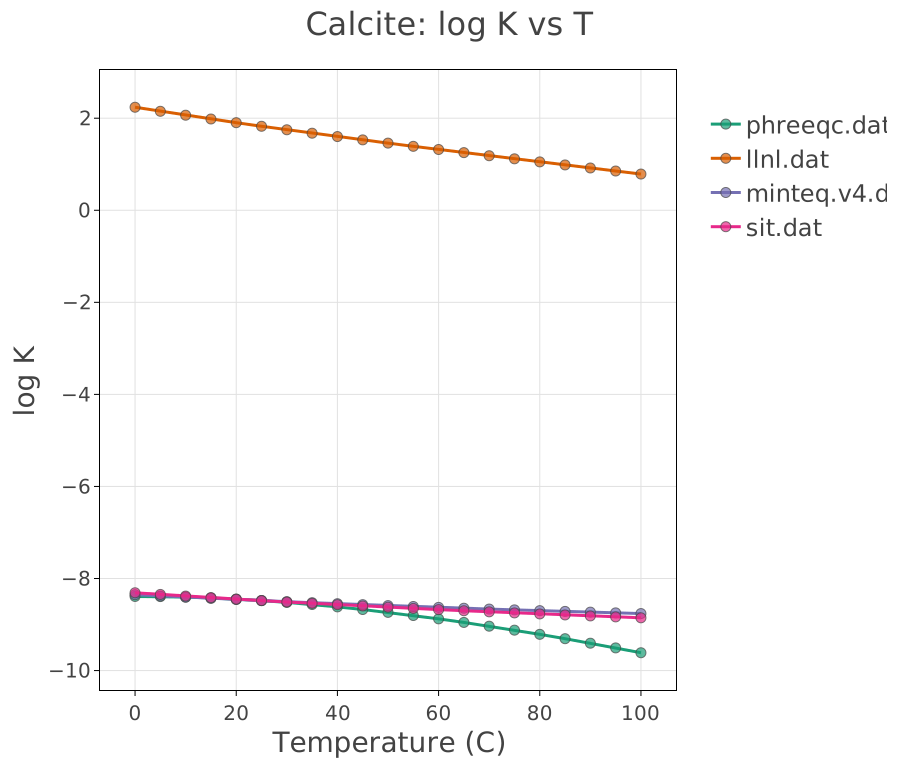
Calcite’s log K from 0 to 100 °C. The curves meet at 25 °C and separate on either side.
At 25 °C, three of the four agree exactly: -8.48 in phreeqc.dat,
minteq.v4.dat and sit.dat. llnl.dat says 1.82.
That is not a disagreement, it is a different reaction. llnl.dat writes
Calcite + H+ = Ca+2 + HCO3-
where the others write calcite dissolving to Ca²⁺ and CO₃²⁻. A log K only
means something with respect to a reaction, so the two numbers are not
comparable, and the study flags the phase and leaves it out of the
comparison rather than reporting a difference of ten log units. Applying
llnl.dat’s own HCO3⁻ = CO3²⁻ + H⁺, log K -10.35, converts its calcite to
-8.53 in the others’ terms – which is very nearly the agreement the raw
numbers hid.
This is the first trap: the same mineral, written as a different reaction. Comparing log K values between databases without checking the reactions they belong to produces nonsense, confidently.
At 100 °C the three that agreed no longer do: -9.61 in phreeqc.dat,
-8.85 in sit.dat, -8.76 in minteq.v4.dat. Same value at 25 °C, three
different temperature dependences. phreeqc.dat uses an analytic
expression fitted to data (Plummer and Busenberg, 1982); the others
extrapolate from a single enthalpy with van’t Hoff, which is exact only if ΔH
does not vary with temperature – and over 75 °C it does.
This is the second trap: agreement at 25 °C says nothing about agreement at your temperature. A model calibrated at laboratory temperature and run hot can drift by a log unit for this reason alone.
Quartz
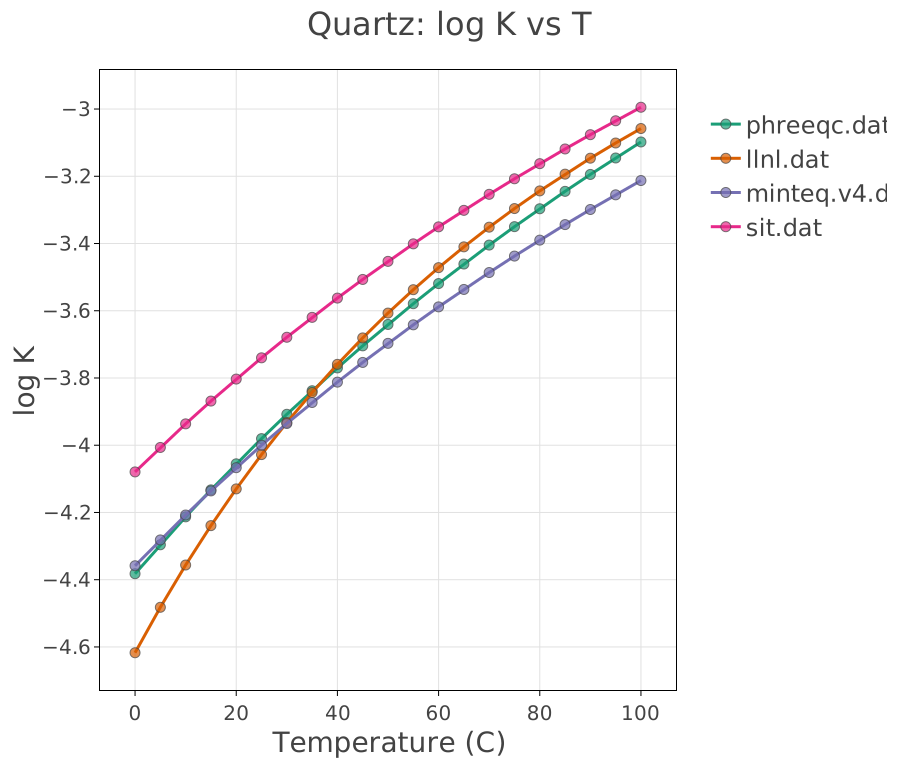
Quartz, the same comparison.
phreeqc.dat gives -3.98 and minteq.v4.dat -4.00, both for
Quartz + 2 H2O = H4SiO4
sit.dat’s -3.74 looks close enough to belong with them, and does not:
its product is written H4(SiO4), a name of its own. llnl.dat writes
Quartz = SiO2. Both are flagged.
This is the third trap, and the quietest: the same species under a
different name. H4SiO4 and H4(SiO4) are the same thing, and nothing
but a human reading the database will say so. A comparison that matched on
names alone would silently report these as unrelated – which is why the
Differences table exists, and why it is worth reading before trusting any
cross-database comparison, including this one.
What it concludes
Four databases, two minerals, three distinct ways of disagreeing that have nothing to do with the underlying thermodynamics being uncertain. Before comparing constants across databases, check the reaction, check the temperature, and check the names.
The practical rule that follows: pick one database for a study and stay with it. Where that is impossible, this study is how the seams are found.
Source
Parkhurst, D. L. and Appelo, C. A. J. (2013). Description of input and examples for PHREEQC version 3. U.S. Geological Survey Techniques and Methods, book 6, chapter A43. The databases compared are those distributed with PHREEQC.
Plummer, L. N. and Busenberg, E. (1982). The solubilities of calcite, aragonite and vaterite in CO2-H2O solutions between 0 and 90 °C, and an evaluation of the aqueous model for the system CaCO3-CO2-H2O. Geochimica et Cosmochimica Acta 46, 1011-1040. The source of
phreeqc.dat’s analytic expression for calcite.