11 - Transport and Cation Exchange
The first transport example, and the one to read before the others. A column holding a sodium-potassium-nitrate water in equilibrium with a cation exchanger is flushed with calcium chloride, and the effluent is followed for three pore volumes.
Everything that makes reactive transport different from transport is visible in one figure.
The column
TITLE Example 11.--Transport and cation exchange.
SOLUTION 0 CaCl2
units mmol/kgw
temp 25.0
pH 7.0 charge
pe 12.5 O2(g) -0.68
Ca 0.6
Cl 1.2
SOLUTION 1-40 Initial solution for column
units mmol/kgw
temp 25.0
pH 7.0 charge
pe 12.5 O2(g) -0.68
Na 1.0
K 0.2
N(5) 1.2
END
EXCHANGE 1-40
-equilibrate 1
X 0.0011
COPY cell 1 101
END
ADVECTION
-cells 40
-shifts 100
-punch_cells 40
-punch_frequency 1
-print_cells 40
-print_frequency 20
PRINT; -reset false; -status false
COPY cell 101 1-40
END
END
TRANSPORT
-cells 40
-lengths 0.002
-shifts 100
-time_step 720.0
-flow_direction forward
-boundary_conditions flux flux
-diffusion_coefficient 0.0e-9
-dispersivities 0.002
-correct_disp true
-punch_cells 40
-punch_frequency 1
-print_cells 40
-print_frequency 20
END
A one-dimensional column, divided into cells, with an exchanger present throughout. Water is advected through it, and at every step every cell is brought to equilibrium with its exchanger. Calcium, potassium and sodium compete for the exchange sites; chloride does not interact with them at all.
That contrast is the experiment. Chloride is a tracer and the cations are not.
The results
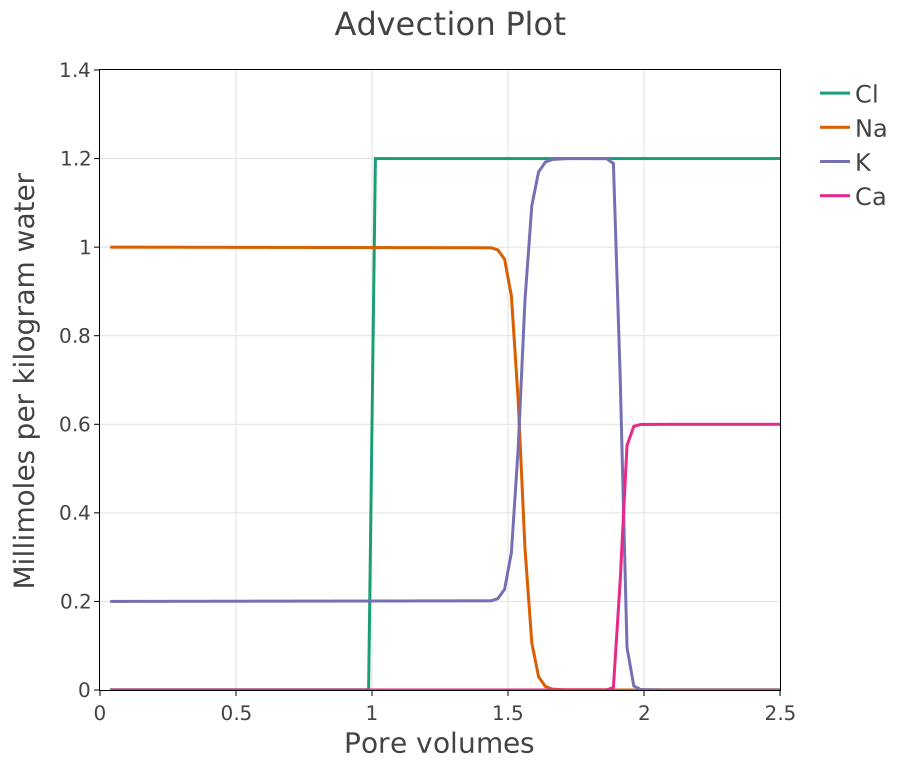
Pure advection, no dispersion. Chloride arrives at one pore volume – it travels at the velocity of the water, because nothing holds it back – and its front is a step, since without dispersion nothing smears it.
The cations arrive later, and not together. Each is retarded by the exchanger in proportion to how strongly it is held, so the column separates them: sodium, then potassium, each displaced in turn by the incoming calcium.
The shapes are not steps. A cation front is self-sharpening or spreading depending on the shape of the exchange isotherm, and the overshoot – where a species comes out more concentrated than it ever went in – is the signature of one ion being driven off the exchanger by another. Chromatography, in a column of sediment.
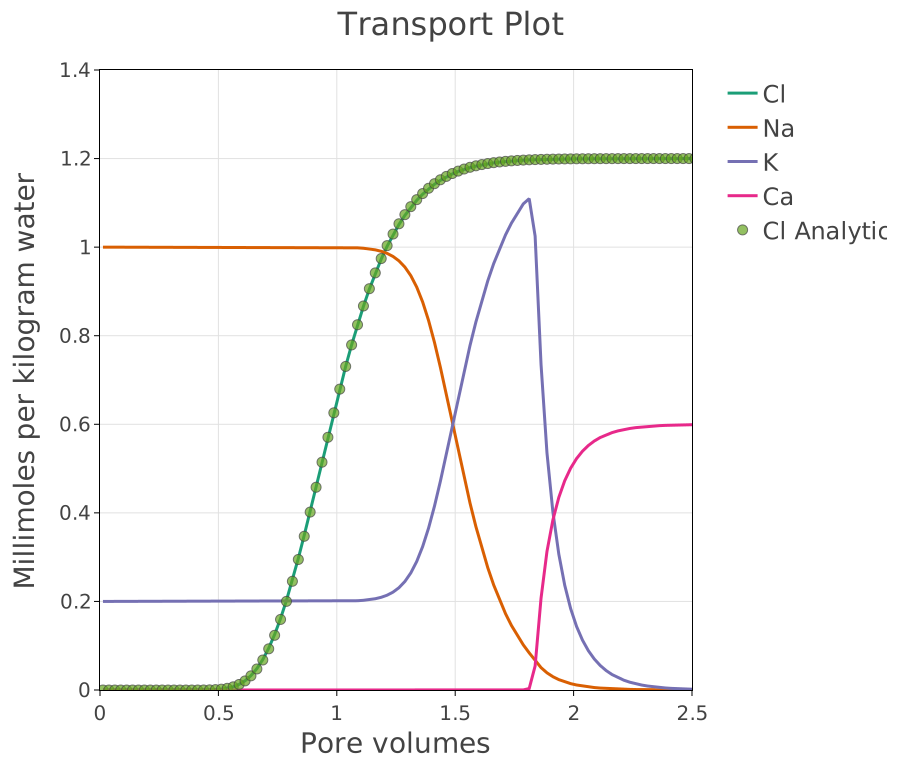
The same with dispersion included, and the analytical solution for chloride drawn alongside. The chloride front is now a smooth curve rather than a step, and it follows the analytical result.
That comparison is a verification, and it is the reason to look at this figure. A reactive transport model has two things that can be wrong – the transport and the chemistry – and a conservative tracer with a known answer isolates the first. If the chloride does not match, nothing about the cations is worth reading.
What it shows
That reaction and transport together produce behaviour neither gives alone: separation, retardation and overshoot. And that the way to trust such a model is to check its conservative tracer against an analytical solution first.
12 - Advective Diffusive Flux extends the verification to heat and diffusion, and 01 - Results Visualization uses this same model to exercise every plot type in the application.
Source
Parkhurst, D. L. and Appelo, C. A. J. (2013). Description of input and examples for PHREEQC version 3. U.S. Geological Survey Techniques and Methods, book 6, chapter A43. This is Example 11 of that manual.
Appelo, C. A. J. and Postma, D. (2005). Geochemistry, Groundwater and Pollution, 2nd edition. Balkema, Leiden. The column experiment this reproduces is theirs.