15 - Transport Kinetic Biodegradation
Cobalt and NTA moving through a column while bacteria degrade the NTA, grow on it, and sorb – transport, kinetics, microbiology and sorption together.
NTA (nitrilotriacetate) is a chelating agent. It binds cobalt into the complex CoNta⁻, which does not sorb, so while the NTA survives the cobalt travels freely. The bacteria eat the NTA. The question is what happens to the cobalt when its ligand is destroyed.
What is coupled
TITLE Example 15.--1D Transport: Kinetic Biodegradation, Cell Growth, and Sorption
***********
PLEASE NOTE: This problem requires database file ex15.dat!!
***********
PRINT
-reset false
-echo_input true
-status false
SOLUTION 0 Pulse solution with NTA and cobalt
units umol/L
pH 6
C .49
O(0) 62.5
Nta 5.23
Co 5.23
Na 1000
Cl 1000
SOLUTION 1-10 Background solution initially filling column
units umol/L
pH 6
C .49
O(0) 62.5
Na 1000
Cl 1000
COPY solution 0 100 # for use later on, and in
COPY solution 1 101 # 20 cells model
END
RATES Rate expressions for the four kinetic reactions
#
HNTA-2
-start
10 Ks = 7.64e-7
20 Ka = 6.25e-6
30 qm = 1.407e-3/3600
40 f1 = MOL("HNta-2")/(Ks + MOL("HNta-2"))
50 f2 = MOL("O2")/(Ka + MOL("O2"))
60 rate = -qm * KIN("Biomass") * f1 * f2
70 moles = rate * TIME
80 PUT(rate, 1) # save the rate for use in Biomass rate calculation
90 SAVE moles
-end
#
Biomass
-start
10 Y = 65.14
20 b = 0.00208/3600
30 rate = GET(1) # uses rate calculated in HTNA-2 rate calculation
40 rate = -Y*rate -b*M
50 moles = -rate * TIME
60 if (M + moles) < 0 then moles = -M
70 SAVE moles
-end
#
Co_sorption
-start
10 km = 1/3600
20 kd = 5.07e-3
30 solids = 3.75e3
40 rate = -km*(MOL("Co+2") - (M/solids)/kd)
50 moles = rate * TIME
60 if (M - moles) < 0 then moles = M
70 SAVE moles
-end
#
CoNta_sorption
-start
10 km = 1/3600
20 kd = 5.33e-4
30 solids = 3.75e3
40 rate = -km*(MOL("CoNta-") - (M/solids)/kd)
50 moles = rate * TIME
60 if (M - moles) < 0 then moles = M
70 SAVE moles
-end
KINETICS 1-10 Four kinetic reactions for all cells
HNTA-2
-formula C -3.12 H -1.968 O -4.848 N -0.424 Nta 1.
Biomass
-formula H 0.0
-m 1.36e-4
Co_sorption
-formula CoCl2
-m 0.0
-tol 1e-11
CoNta_sorption
-formula NaCoNta
-m 0.0
-tol 1e-11
COPY kinetics 1 101 # to use with 20 cells
END
TRANSPORT First 20 hours have NTA and cobalt in infilling solution
-cells 10
-lengths 1
-shifts 20
-time_step 3600
-flow_direction forward
-boundary_conditions flux flux
-dispersivities .05
-correct_disp true
-diffusion_coefficient 0.0
-punch_cells 10
-punch_frequency 1
-print_cells 10
-print_frequency 5
COPY solution 101 0 # initial column solution becomes influent
END
TRANSPORT Last 55 hours with background infilling solution
-shifts 55
COPY cell 100 0 # for the 20 cell model...
COPY cell 101 1-20
END
TRANSPORT First 20 hours have NTA and cobalt in infilling solution
-cells 20
-lengths 0.5
-shifts 40
-initial_time 0
-time_step 1800
-flow_direction forward
-boundary_conditions flux flux
-dispersivities .05
-correct_disp true
-diffusion_coefficient 0.0
-punch_cells 20
-punch_frequency 2
-print_cells 20
-print_frequency 10
COPY cell 101 0
END
TRANSPORT Last 55 hours with background infilling solution
-shifts 110
END
Transport along the column.
Kinetic biodegradation of NTA, with the rate depending on the amount of biomass.
Microbial growth: the biomass increases as it consumes the substrate, so the rate accelerates as the reaction proceeds.
Sorption of cobalt, which depends on its speciation.
The growth term is what makes this more than a decay model. The rate is not a constant: it feeds back on itself, so degradation is slow until the population establishes and then fast.
The results
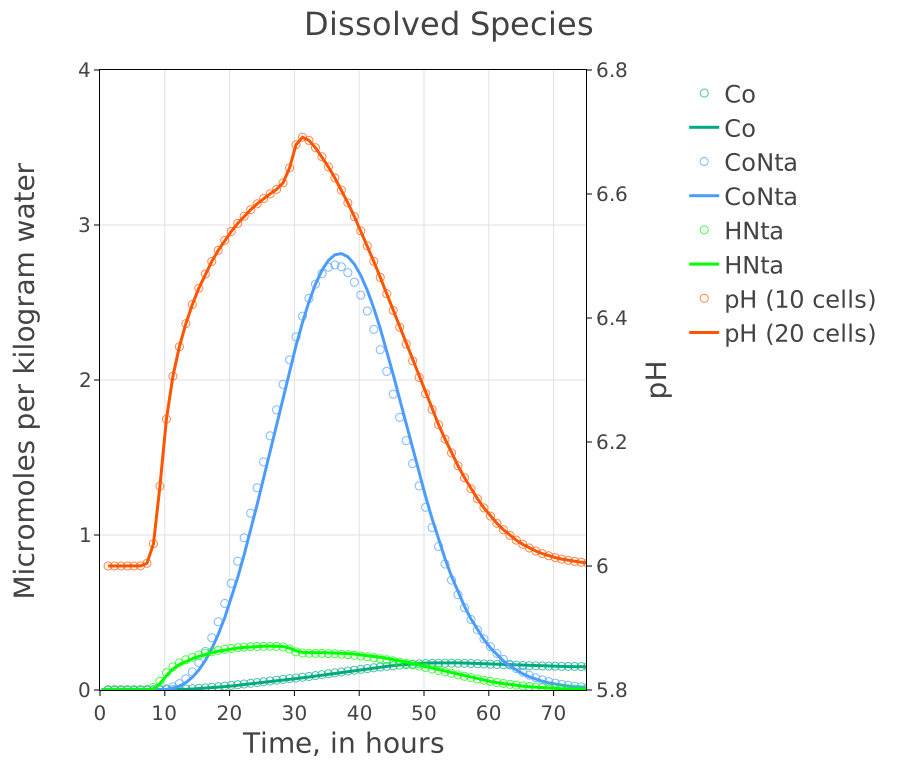
Dissolved species against time. CoNta⁻ is the mobile form, and it falls as the NTA is degraded. Free Co²⁺ appears as its ligand is destroyed, and free cobalt sorbs – so biodegradation of the chelator immobilises the metal.
That is the result, and it is counter-intuitive enough to be worth stating plainly: degrading the organic contaminant is what stops the metal moving.
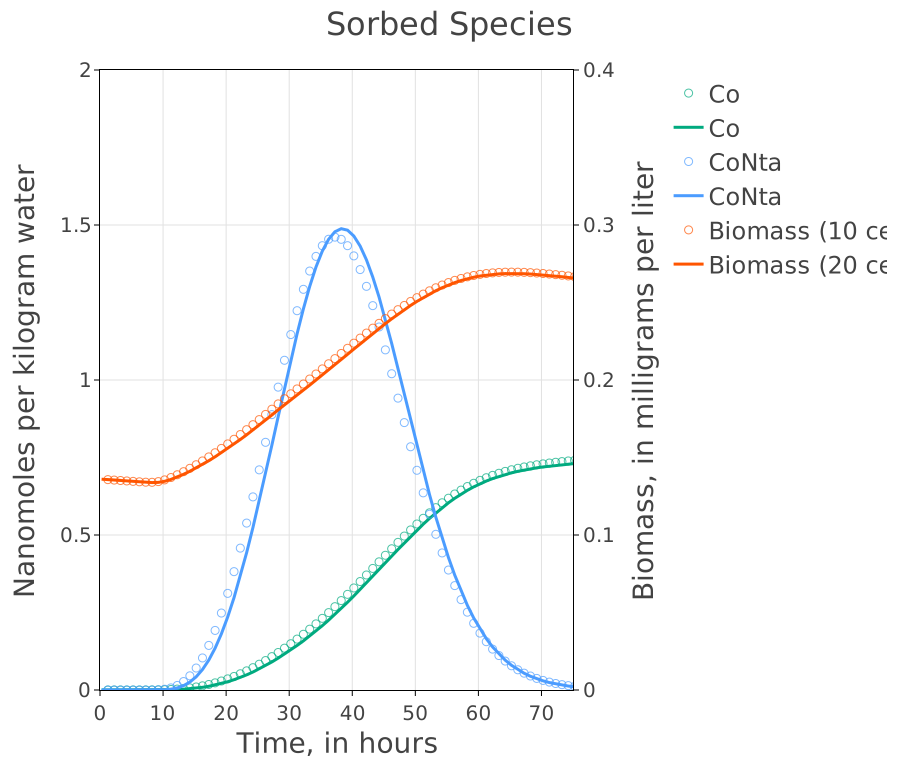
Sorbed species and biomass. Sorbed cobalt rises as the dissolved free cobalt appears, and the biomass curve shows the growth that drove the whole sequence.
Both figures are drawn twice, at 10 cells and 20 cells. That is the convergence check of 12 - Advective Diffusive Flux, applied to a problem with no analytical solution to compare against – which is the usual situation. Where the two resolutions agree, the result is a property of the model; where they differ, it is a property of the grid.
With a growing biomass and a sharp degradation front, this check is not optional. A reaction rate that depends on its own product is exactly the kind of non-linearity that a coarse grid resolves badly and silently.
Source
Parkhurst, D. L. and Appelo, C. A. J. (2013). Description of input and examples for PHREEQC version 3. U.S. Geological Survey Techniques and Methods, book 6, chapter A43. This is Example 15 of that manual.
The Co-NTA system and its degradation kinetics follow Tebes-Stevens, C., Valocchi, A. J., VanBriesen, J. M. and Rittmann, B. E. (1998), Multicomponent transport with coupled geochemical and microbiological reactions, Journal of Hydrology 209, 8-26.