09 - Kinetic Oxidation
Dissolved ferrous iron meeting oxygen. Thermodynamically the answer is immediate – Fe(II) is not stable in oxygenated water – so an equilibrium calculation says all the iron is Fe(III) and stops there.
The useful question is how long, and that needs a rate.
A rate law in the input
TITLE Example 9.--Kinetically controlled oxidation of ferrous
iron. Decoupled valence states of iron.
SOLUTION_MASTER_SPECIES
Fe_di Fe_di+2 0.0 Fe_di 55.847
Fe_tri Fe_tri+3 0.0 Fe_tri 55.847
SOLUTION_SPECIES
Fe_di+2 = Fe_di+2
log_k 0.0
Fe_tri+3 = Fe_tri+3
log_k 0.0
#
# Fe+2 species
#
Fe_di+2 + H2O = Fe_diOH+ + H+
log_k -9.5
delta_h 13.20 kcal
#
#... and also other Fe+2 species
#
Fe_di+2 + Cl- = Fe_diCl+
log_k 0.14
Fe_di+2 + CO3-2 = Fe_diCO3
log_k 4.38
Fe_di+2 + HCO3- = Fe_diHCO3+
log_k 2.0
Fe_di+2 + SO4-2 = Fe_diSO4
log_k 2.25
delta_h 3.230 kcal
Fe_di+2 + HSO4- = Fe_diHSO4+
log_k 1.08
Fe_di+2 + 2HS- = Fe_di(HS)2
log_k 8.95
Fe_di+2 + 3HS- = Fe_di(HS)3-
log_k 10.987
Fe_di+2 + HPO4-2 = Fe_diHPO4
log_k 3.6
Fe_di+2 + H2PO4- = Fe_diH2PO4+
log_k 2.7
Fe_di+2 + F- = Fe_diF+
log_k 1.0
#
# Fe+3 species
#
Fe_tri+3 + H2O = Fe_triOH+2 + H+
log_k -2.19
delta_h 10.4 kcal
#
#... and also other Fe+3 species
#
Fe_tri+3 + 2 H2O = Fe_tri(OH)2+ + 2 H+
log_k -5.67
delta_h 17.1 kcal
Fe_tri+3 + 3 H2O = Fe_tri(OH)3 + 3 H+
log_k -12.56
delta_h 24.8 kcal
Fe_tri+3 + 4 H2O = Fe_tri(OH)4- + 4 H+
log_k -21.6
delta_h 31.9 kcal
2 Fe_tri+3 + 2 H2O = Fe_tri2(OH)2+4 + 2 H+
log_k -2.95
delta_h 13.5 kcal
3 Fe_tri+3 + 4 H2O = Fe_tri3(OH)4+5 + 4 H+
log_k -6.3
delta_h 14.3 kcal
Fe_tri+3 + Cl- = Fe_triCl+2
log_k 1.48
delta_h 5.6 kcal
Fe_tri+3 + 2 Cl- = Fe_triCl2+
log_k 2.13
Fe_tri+3 + 3 Cl- = Fe_triCl3
log_k 1.13
Fe_tri+3 + SO4-2 = Fe_triSO4+
log_k 4.04
delta_h 3.91 kcal
Fe_tri+3 + HSO4- = Fe_triHSO4+2
log_k 2.48
Fe_tri+3 + 2 SO4-2 = Fe_tri(SO4)2-
log_k 5.38
delta_h 4.60 kcal
Fe_tri+3 + HPO4-2 = Fe_triHPO4+
log_k 5.43
delta_h 5.76 kcal
Fe_tri+3 + H2PO4- = Fe_triH2PO4+2
log_k 5.43
Fe_tri+3 + F- = Fe_triF+2
log_k 6.2
delta_h 2.7 kcal
Fe_tri+3 + 2 F- = Fe_triF2+
log_k 10.8
delta_h 4.8 kcal
Fe_tri+3 + 3 F- = Fe_triF3
log_k 14.0
delta_h 5.4 kcal
PHASES
Goethite
Fe_triOOH + 3 H+ = Fe_tri+3 + 2 H2O
log_k -1.0
END
SOLUTION 1
pH 7.0
pe 10.0 O2(g) -0.67
Fe_di 0.1
Na 10.
Cl 10. charge
EQUILIBRIUM_PHASES 1
O2(g) -0.67
RATES
Fe_di_ox
-start
10 Fe_di = TOT("Fe_di")
20 if (Fe_di <= 0) then goto 200
30 p_o2 = SR("O2(g)")
40 moles = (2.91e-9 + 1.33e12 * (ACT("OH-"))^2 * p_o2) * Fe_di * TIME
200 SAVE moles
-end
KINETICS 1
Fe_di_ox
-formula Fe_di -1.0 Fe_tri 1.0
-steps 100 400 3100 10800 21600 5.04e4 8.64e4 1.728e5 1.728e5 1.728e5 1.728e5
-step_divide 1e-4
INCREMENTAL_REACTIONS true
END
The oxidation rate of ferrous iron is strongly dependent on pH – it goes as
the square of the hydroxide activity, so a unit of pH is a hundredfold in
rate – and on the oxygen partial pressure. That law is written into a
RATES block as BASIC, and a KINETICS block integrates it over time.
This is the general shape of a kinetic model in PHREEQC: the equilibrium calculation gives the speciation at each instant, and the rate law says how fast the irreversible step proceeds. The two are solved together at every step, so the rate sees the current pH and the current speciation rather than the starting ones.
The result
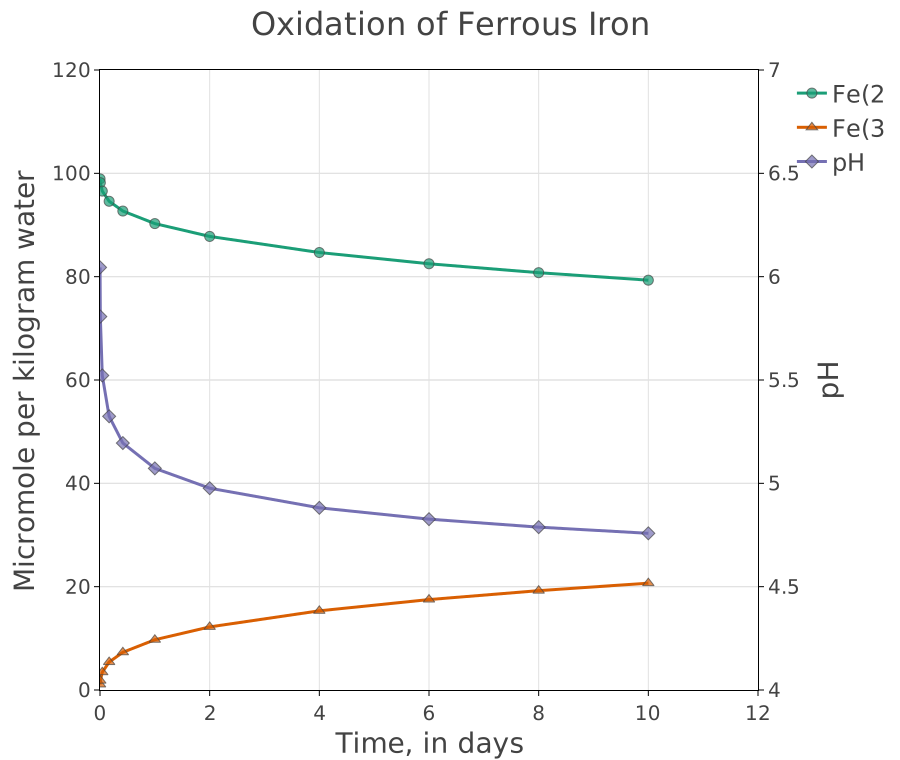
Fe(II) falling and Fe(III) rising over several days, with pH on the same axes.
The pH curve is the one to watch, and it is why the two species are not simple mirror images. Oxidising ferrous iron and precipitating the ferric product releases acid, so the pH falls as the reaction proceeds – and since the rate depends on the square of the hydroxide activity, the reaction slows itself down. The system is self-limiting through its own product.
An equilibrium model gives none of this. It gives the endpoint, which was never in doubt.
What it shows
That kinetics is required whenever the rate is comparable with the timescale of interest, and that a rate law coupled to a speciation calculation can show feedback that neither would show alone.
The practical case is iron removal from groundwater: the time to oxidise the iron, and therefore the size of the plant, depends on a pH that the reaction itself is changing.
Source
Parkhurst, D. L. and Appelo, C. A. J. (2013). Description of input and examples for PHREEQC version 3. U.S. Geological Survey Techniques and Methods, book 6, chapter A43. This is Example 9 of that manual.
Singer, P. C. and Stumm, W. (1970). Acidic mine drainage: the rate- determining step. Science 167, 1121-1123, for the rate law’s form.