10 - Solid Solution
Aragonite and strontianite – CaCO₃ and SrCO₃ – are not two separate minerals that happen to be present together. They form a solid solution: one crystal structure in which calcium and strontium substitute for each other in any proportion.
That changes the thermodynamics. A pure phase has a fixed solubility product; a solid solution’s depends on its composition, and its composition depends on the water it grew from, which in turn depends on what it has taken out. The example works through the consequences.
The calculation
TITLE Example 10.--Solid solution of strontianite and aragonite.
PHASES
Strontianite
SrCO3 = CO3-2 + Sr+2
log_k -9.271
Aragonite
CaCO3 = CO3-2 + Ca+2
log_k -8.336
END
SOLID_SOLUTIONS 1
Ca(x)Sr(1-x)CO3
-comp1 Aragonite 0
-comp2 Strontianite 0
-Gugg_nondim 3.43 -1.82
END
SOLUTION 1
-units mmol/kgw
pH 5.93 charge
Ca 3.932
C 7.864
EQUILIBRIUM_PHASES 1
CO2(g) -0.01265 10
Aragonite
SAVE solution 1
END
#
# Total of 0.00001 to 0.005 moles of SrCO3 added
#
USE solution 1
USE solid_solution 1
REACTION 1
SrCO3 1.0
.005 in 500 steps
PRINT
-reset false
-echo true
-user_print true
USER_PRINT
-start
10 sum = (S_S("Strontianite") + S_S("Aragonite"))
20 if sum = 0 THEN GOTO 110
30 xb = S_S("Strontianite")/sum
40 xc = S_S("Aragonite")/sum
50 PRINT "Simulation number: ", SIM_NO
60 PRINT "Reaction step number: ", STEP_NO
70 PRINT "SrCO3 added: ", RXN
80 PRINT "Log Sigma pi: ", LOG10 (ACT("CO3-2") * (ACT("Ca+2") + ACT("Sr+2")))
90 PRINT "XAragonite: ", xc
100 PRINT "XStrontianite: ", xb
110 PRINT "XCa: ", TOT("Ca")/(TOT("Ca") + TOT("Sr"))
120 PRINT "XSr: ", TOT("Sr")/(TOT("Ca") + TOT("Sr"))
130 PRINT "Misc 1: ", MISC1("Ca(x)Sr(1-x)CO3")
140 PRINT "Misc 2: ", MISC2("Ca(x)Sr(1-x)CO3")
-end
END
#
# Total of 0.005 to 0.1 moles of SrCO3 added
#
USE solution 1
USE solid_solution 1
REACTION 1
SrCO3 1.0
.1 in 20 steps
END
#
# Total of 0.1 to 10 moles of SrCO3 added
#
USE solution 1
USE solid_solution 1
REACTION 1
SrCO3 1.0
10.0 in 100 steps
END
SrCO₃ is added progressively to a system containing the aragonite- strontianite solid solution, and four quantities are followed.
The results
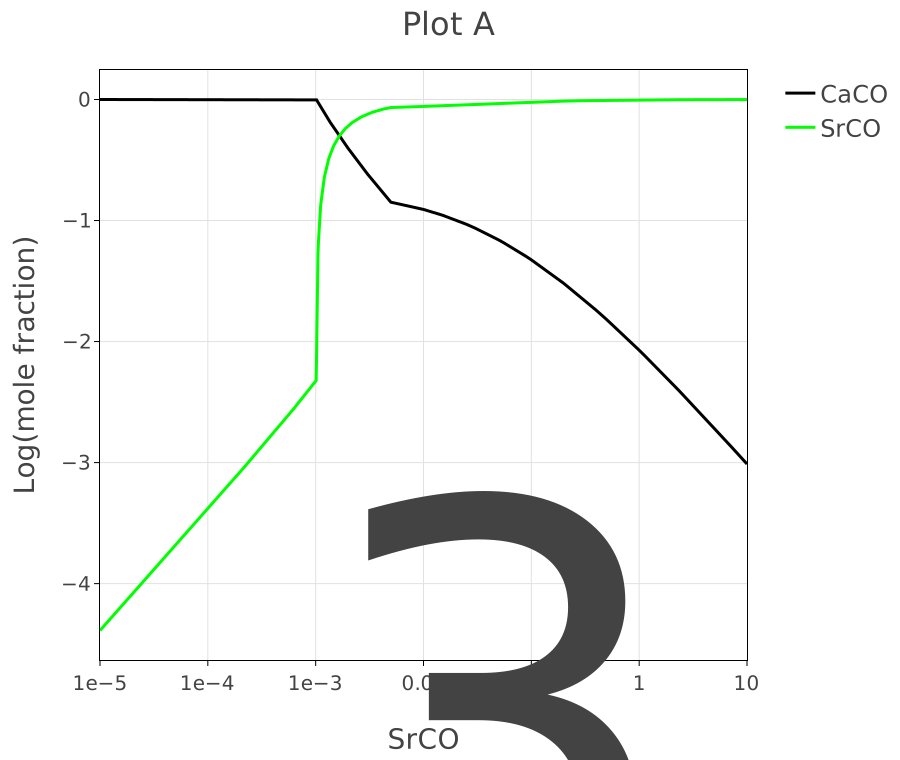
A – the composition of the solid. Mole fractions of the two components as strontium is added. This is what distinguishes a solid solution from a mixture of phases: there is one solid and its composition moves continuously.
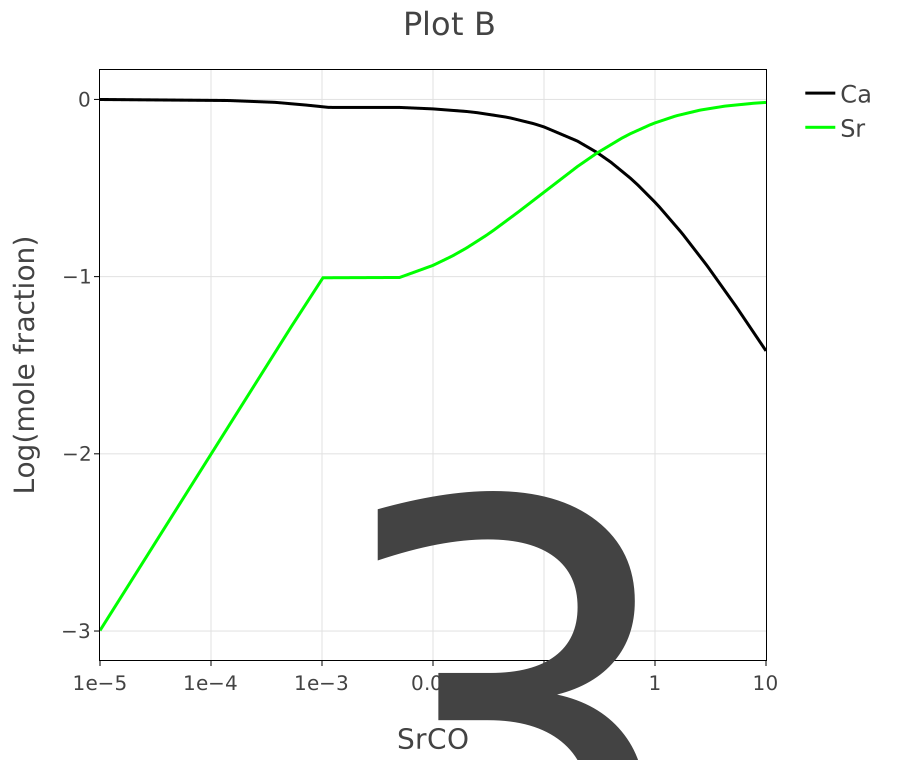
B – the water in equilibrium with it. Calcium and strontium in solution. The ratio here is not the ratio in the solid: the solid preferentially takes one of the two, and the fractionation between them is the distribution coefficient.
This is the quantity that makes solid solutions worth modelling. It is why the strontium content of a carbonate records the water it formed from, and it is the basis of a good deal of palaeo-environmental reconstruction.
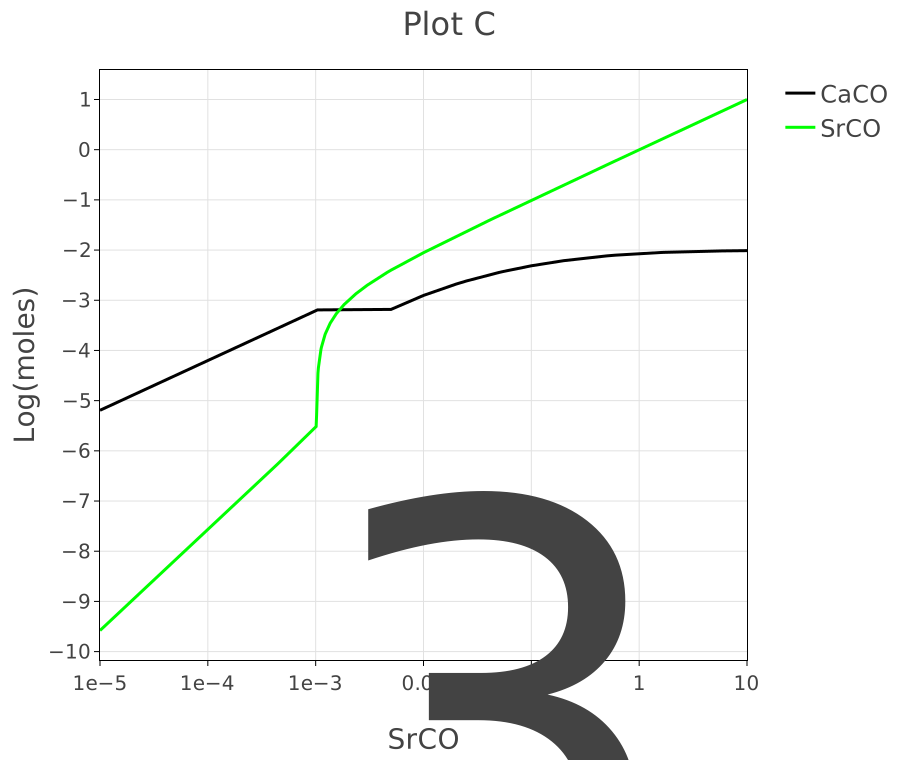
C – the amounts. Moles of each component in the solid, rather than fractions.
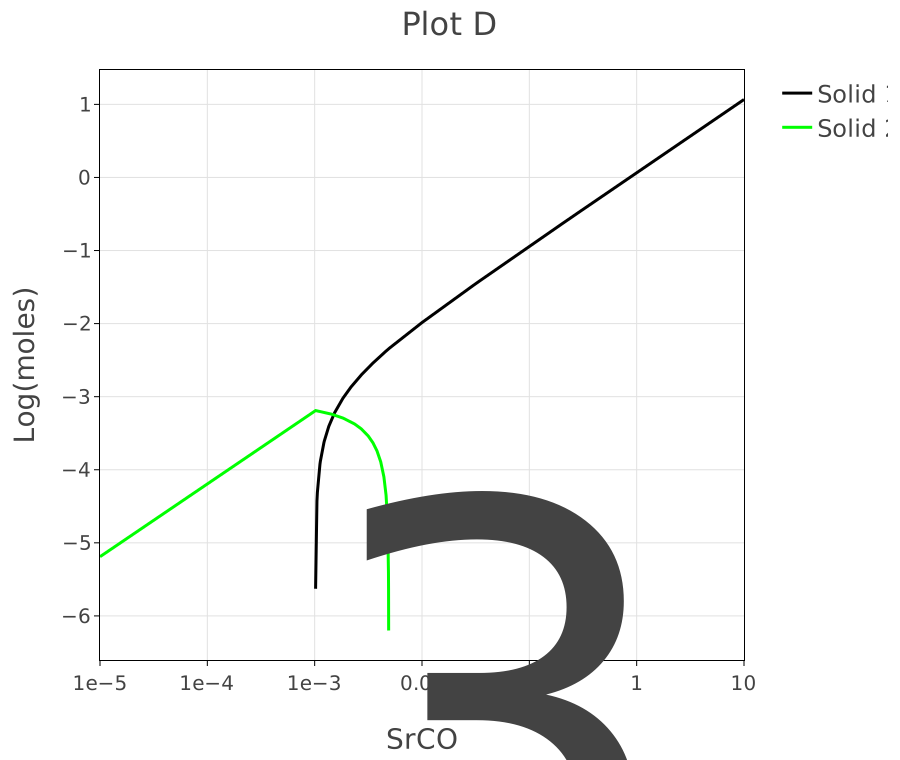
D – two solids. Over part of the range the system does not stay as one solid: the solid solution unmixes into two solids of different composition, and both are present together.
That is a miscibility gap, and it is the same phenomenon as oil and water refusing to mix. Where the two end members are sufficiently unlike – and Ca²⁺ and Sr²⁺ differ enough in size – there is a range of compositions that is unstable, and a solid in that range separates into two.
A model treating these as two independent pure phases would never produce this, and would also get the composition in plot A wrong everywhere else.
What it shows
That solid solutions need their own thermodynamics, and that the behaviour that follows – fractionation between solid and water, and unmixing – is not reproducible by treating the components separately.
Source
Parkhurst, D. L. and Appelo, C. A. J. (2013). Description of input and examples for PHREEQC version 3. U.S. Geological Survey Techniques and Methods, book 6, chapter A43. This is Example 10 of that manual.
Glynn, P. D. and Reardon, E. J. (1990). Solid-solution aqueous-solution equilibria: thermodynamic theory and representation. American Journal of Science 290, 164-201.