14 - Transport Cation Exchange and Surface Complexation
The one that puts everything together: advective transport with mineral equilibria, cation exchange and surface complexation all active at once, on a real aquifer.
The Central Oklahoma aquifer has naturally high arsenic and high pH, and the question is where they come from. The model follows water through the aquifer and lets the three kinds of reaction compete.
Three reaction types, one column
TITLE Example 14.--Transport with equilibrium_phases, exchange, and surface reactions
#
# Use phreeqc.dat
# Dzombak and Morel (1990) aqueous and surface complexation models for arsenic
# are defined here
#
SURFACE_MASTER_SPECIES
Surf SurfOH
SURFACE_SPECIES
SurfOH = SurfOH
log_k 0.0
SurfOH + H+ = SurfOH2+
log_k 7.29
SurfOH = SurfO- + H+
log_k -8.93
SurfOH + AsO4-3 + 3H+ = SurfH2AsO4 + H2O
log_k 29.31
SurfOH + AsO4-3 + 2H+ = SurfHAsO4- + H2O
log_k 23.51
SurfOH + AsO4-3 = SurfOHAsO4-3
log_k 10.58
SOLUTION_MASTER_SPECIES
As H3AsO4 -1.0 74.9216 74.9216
SOLUTION_SPECIES
H3AsO4 = H3AsO4
log_k 0.0
H3AsO4 = AsO4-3 + 3H+
log_k -20.7
H+ + AsO4-3 = HAsO4-2
log_k 11.50
2H+ + AsO4-3 = H2AsO4-
log_k 18.46
SOLUTION 1 Brine
pH 5.713
pe 4.0 O2(g) -0.7
temp 25.
units mol/kgw
Ca .4655
Mg .1609
Na 5.402
Cl 6.642 charge
C .00396
S .004725
As .025 umol/kgw
END
USE solution 1
EQUILIBRIUM_PHASES 1
Dolomite 0.0 1.6
Calcite 0.0 0.1
SAVE solution 1
# prints initial condition to the selected-output file
END
PRINT
# skips print of initial exchange and initial surface to the selected-output file
-selected_out false
EXCHANGE 1
-equil with solution 1
X 1.0
SURFACE 1
-equil solution 1
# assumes 1/10 of iron is HFO
SurfOH 0.07 600. 30.
END
SOLUTION 0 20 x precipitation
pH 4.6
pe 4.0 O2(g) -0.7
temp 25.
units mmol/kgw
Ca .191625
Mg .035797
Na .122668
Cl .133704
C .01096
S .235153 charge
EQUILIBRIUM_PHASES 0
Dolomite 0.0 1.6
Calcite 0.0 0.1
CO2(g) -1.5 10.
SAVE solution 0
END
PRINT
-selected_out true
-status false
ADVECTION
-cells 1
-shifts 200
-print_frequency 200
END
Mineral equilibria – dissolution and precipitation of the phases present.
Cation exchange – the clays, holding and releasing the major cations.
Surface complexation – the iron oxides, holding arsenic.
Each has had an example of its own (11 - Transport and Cation Exchange for exchange, 08 - Surface Complexation for surfaces). Here they interact, and the interaction is the result: the arsenic is not controlled by arsenic chemistry but by what the other two do to the pH.
The result
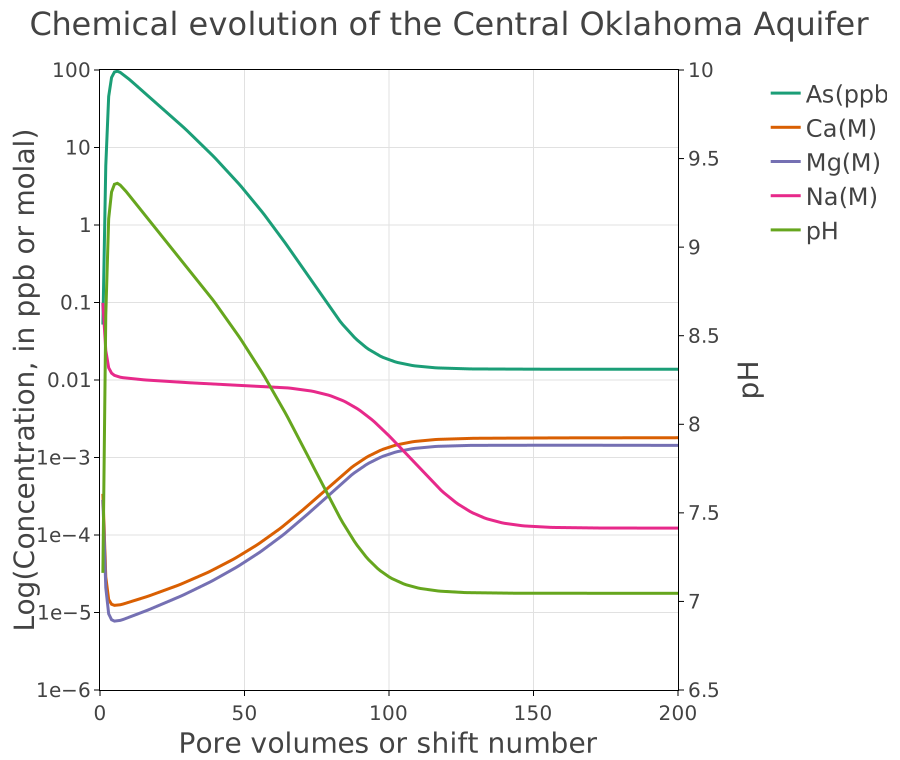
Arsenic in ppb, the major cations in molal, and pH, against pore volumes. Note the logarithmic concentration axis – arsenic and the major ions differ by orders of magnitude and would not otherwise share a figure.
Read it as a chain. The cation exchange replaces calcium and magnesium on the clays with sodium, which softens the water. Losing calcium lets carbonate equilibria push the pH up. And arsenic sorbs to iron oxide surfaces less and less well as pH rises, because the surface becomes more negative while arsenate is an anion – so the arsenic is released.
Arsenic rises because of what sodium did to the clays. Nothing about arsenic’s own chemistry changed.
What it shows
That a model with one process cannot find this. Exchange alone would predict softening; surface complexation alone would predict arsenic sorbing at whatever pH it was given. Coupling them produces the mechanism, and the mechanism is what tells you which aquifers to worry about.
This is also the practical argument for reactive transport over a batch calculation: the sequence of waters a parcel of rock sees is what drives the release, and that sequence only exists if the water is moving.
Source
Parkhurst, D. L. and Appelo, C. A. J. (2013). Description of input and examples for PHREEQC version 3. U.S. Geological Survey Techniques and Methods, book 6, chapter A43. This is Example 14 of that manual.
The Central Oklahoma aquifer study it is based on is Parkhurst, D. L., Christenson, S. and Breit, G. N. (1996), Ground-water-quality assessment of the Central Oklahoma aquifer, Oklahoma – geochemical and geohydrologic investigations, U.S. Geological Survey Water-Supply Paper 2357-C.